The Bing Maps API retirement timeline
Microsoft announced on May 21, 2024 that it is unifying its enterprise maps products under Azure Maps and that Bing Maps for Enterprise will be retired. From June 30, 2024 no new customers can license Bing Maps for Enterprise, and its services and product support end on June 30, 2028.
Microsoft's documentation adds that Bing Maps for Enterprise is deprecated and already retired for all free (Basic) account customers, while enterprise account customers can keep using it until June 30, 2028 and must update their REST API and SDK integrations to Azure Maps before then.
Azure Maps as the replacement
Azure Maps includes many of the same features as Bing Maps for Enterprise, and its search (fuzzy and POI search) is the equivalent of Bing's points-of-interest search. The pricing page lists 5,000 free search transactions a month; for volume above that, use Microsoft's pricing calculator or contact sales, with volume discounts from 100,000 transactions a month. It is the right choice for maps, geocoding and routing inside your own app.
For lead lists and market research, map APIs are a poor fit: they return points of interest for display, under licence terms that usually restrict storing and reselling the data. What you want there is the business listing itself, exported to a table.
Bing Maps scraper: business listings
The Bing Maps Scraper takes search terms (pizza, dentist) and locations (Detroit, MI), runs every term in every location and returns one row per business: name, categories, phone, address, website, rating, review count, latitude and longitude, open-now flag, image and Bing Maps link. Places found by more than one search are deduplicated by place ID.
A limit applies to each search and location pair. Email enrichment and review text are not included, and coverage varies by area. It costs $0.03 / 1,000 results, so 10,000 businesses cost $0.30, against $0.2 / 1,000 results for the Google Maps Scraper. That makes Bing a cheap second source to widen a Google Maps lead list.
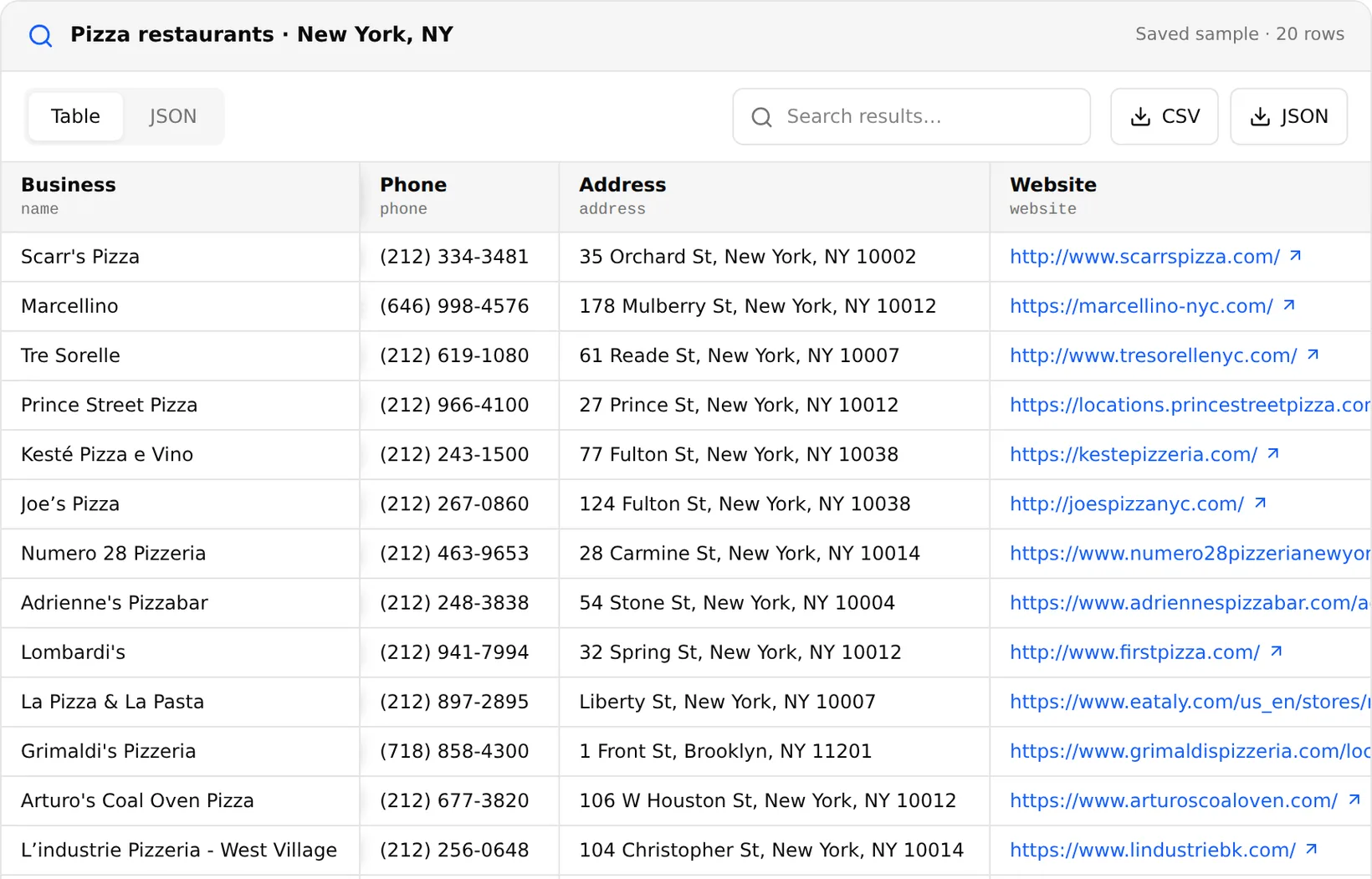
Bing Maps data in Python
import requests

response = requests.post(
    "https://extracto.cloud/api/v1/parsers/bing-maps-scraper?wait=1",
    headers={"X-API-KEY": "ext_your_api_key", "Idempotency-Key": "bing-pizza-detroit-2026-11-20"},
    json={"input": {"searchQueries": ["pizza"], "locations": ["Detroit, MI"], "maxPlacesPerQuery": 100, "market": "en-US"}},
    timeout=600,
)
for b in response.json()["data"]:
    print(b["name"], b.get("phone"), b.get("website"), b.get("rating"), b.get("reviewCount"))
What people use Bing Maps data for
- Lead lists: local businesses with phones and websites, merged with Google Maps results.
- Listing audits: whether your locations show correctly on Bing Maps.
- Market sizing: how many businesses of a type operate in a city.
- Data enrichment: coordinates and categories for an existing business list.