What a Facebook scraper collects
| Scraper | Input | One result is | Price |
|---|---|---|---|
| Facebook Pages | Page usernames or URLs | One page profile | $3 / 1,000 results |
| Facebook Posts | Page or profile URLs, a post limit, date filters | One post | $5 / 1,000 results |
| Facebook Marketplace | Keywords and a city or ZIP code, or a Marketplace search URL | One listing | $0.3 / 1,000 results |
Facebook page scraper
The Facebook Pages Scraper takes page usernames such as NASA or full page URLs and returns one profile per page: name, username, page ID, verified badge, category, bio and description, follower and following counts, "talking about this" count, websites, contact email, creation date, whether the page is running ads and who is confirmed as responsible for it. A page that fills in its contact email makes this a simple Facebook email scraper for businesses; the email scraper guide covers the other sources.
Facebook post scraper
The Facebook Posts Scraper collects the latest public posts of a page. Each row has the post text, URL, date, likes, comments count, shares, reactions by type (like, love, care, wow, haha, angry), media, links mentioned in the text and, for videos, the view count. You can stop at a number of posts or limit by date, for example only posts from the last 7 days, and optionally collect captions of video posts.
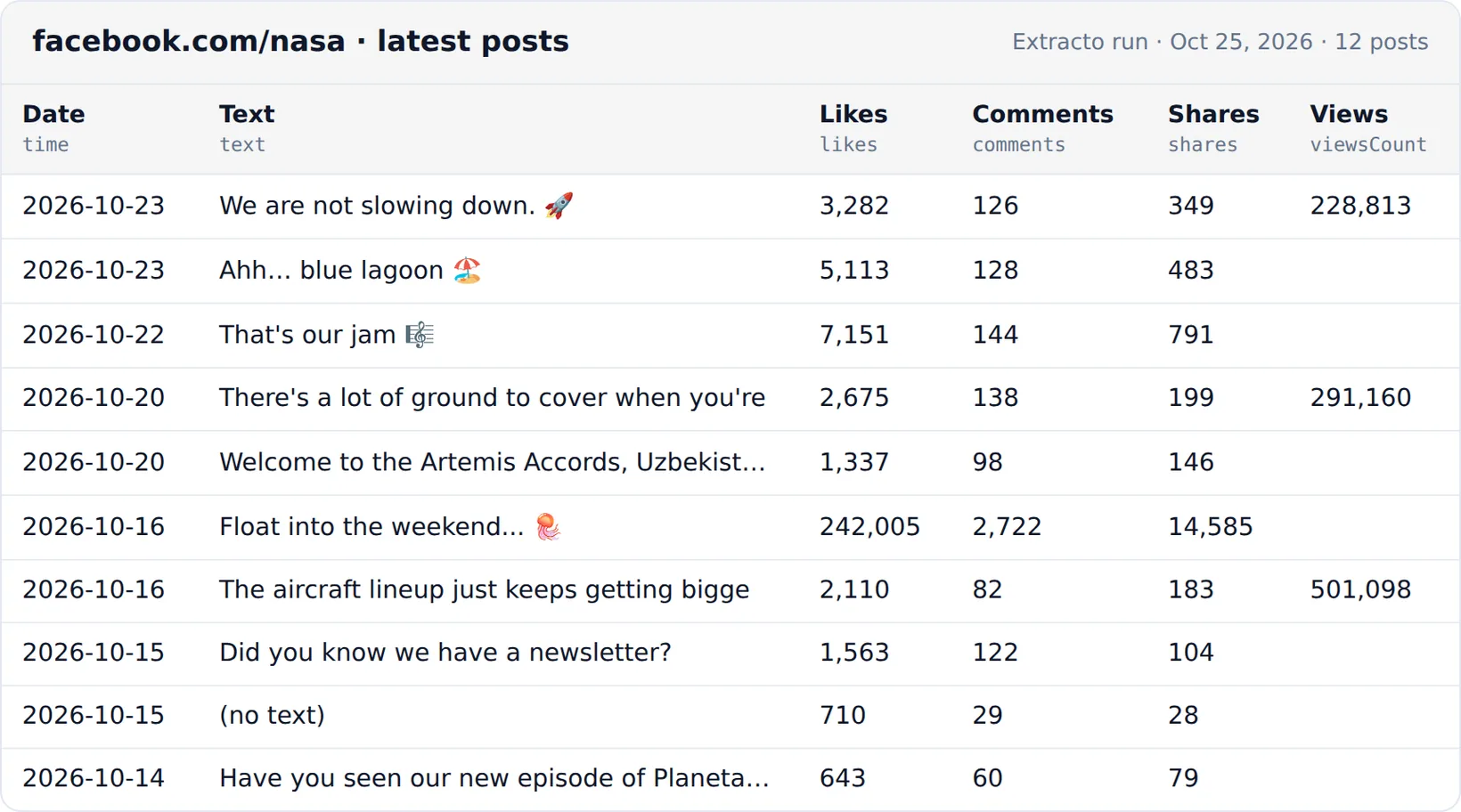
It is a Facebook posts scraper, not a Facebook comment scraper: comment counts are included, comment text is not. 1,000 posts cost $5.00.
Facebook Marketplace scraper
The Facebook Marketplace Scraper searches Marketplace the way a buyer does: a keyword such as honda civic plus a city, neighborhood or ZIP code, which Facebook searches within about 40 miles. Add more locations to run the same search in several cities, or leave the keywords empty to get the newest listings in each category. Each listing has the title, price, city, state, URL, photo, listing time and delivery options.
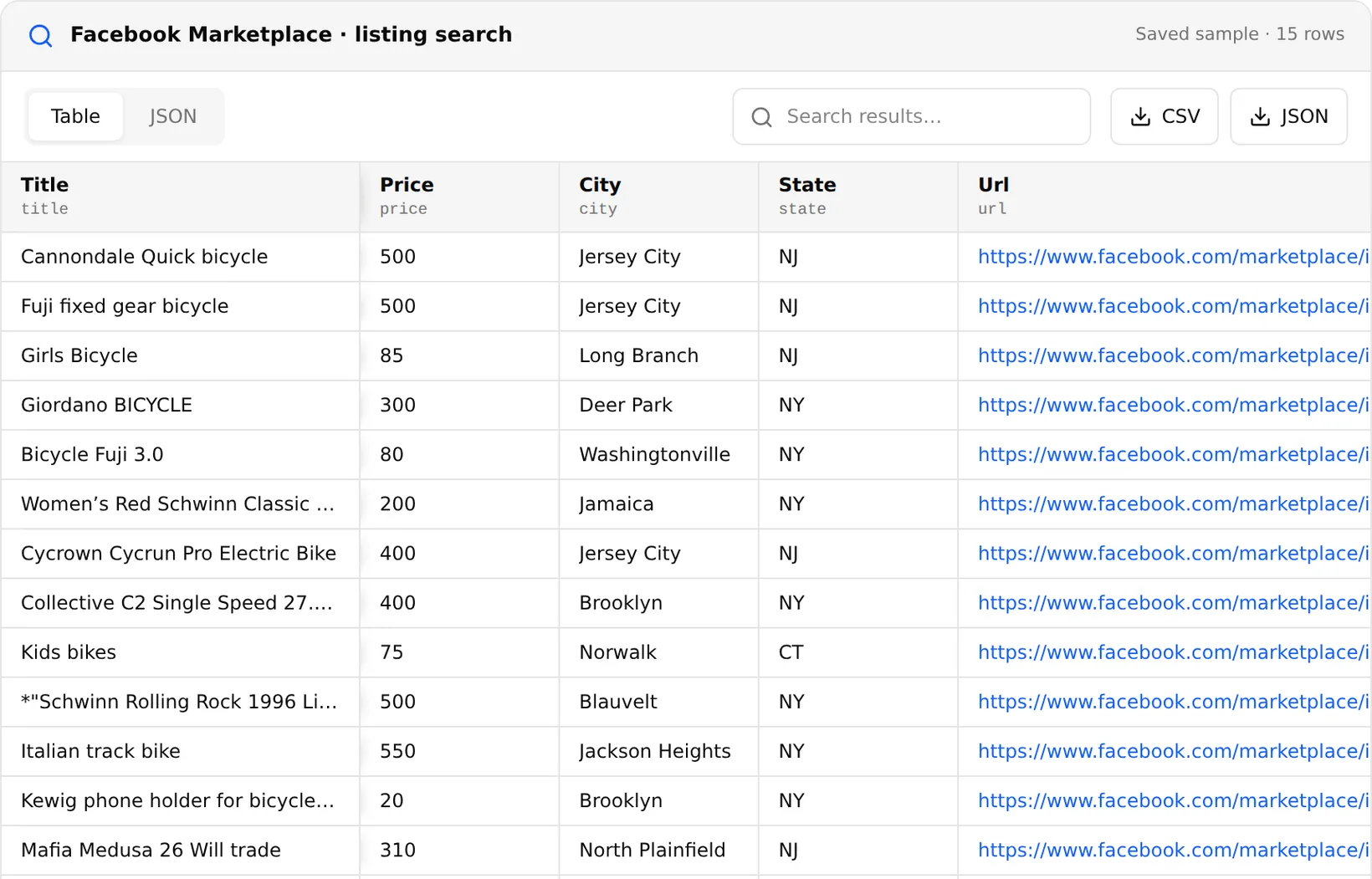
Facebook mixes loosely related items into search results, so the scraper can keep only titles that contain your keywords, drop titles with words like parts or wanted, and filter by price. Facebook shows 24 listings per search page; for more, the scraper splits the search into price ranges. 1,000 listings cost $0.30.
Meta's API and research tools
- Graph API, Page Public Content Access: reads public posts and comments of pages for analysis or display, but your app must pass App Review and business verification first.
- CrowdTangle: Meta's social monitoring tool closed on August 14, 2024. Its replacement, the Meta Content Library, is for researchers at academic and non-profit institutions, who apply and are reviewed before getting access.
- Marketplace: the only Marketplace APIs are for approved partners who upload and update listings. There is no public API for searching listings.
If you qualify for official access and need comment text, use it. For competitor benchmarking, page lists and Marketplace prices, scraping public pages is the practical route.
Facebook scraper in Python and GitHub tools
A Facebook web scraper you write yourself is possible: open-source Facebook scraper Python libraries and Facebook Marketplace scraper GitHub projects exist and are worth studying. In practice Facebook often asks logged-out visitors to log in, changes its page structure often and blocks repeated requests, so these scripts need regular fixes, and logging in with an account to get around the wall risks that account. If you compare hosted options, compare the price per 1,000 listings, location coverage and whether irrelevant listings are filtered out.
What Extracto does not collect
- Private profiles, friend and follower lists.
- Private groups, and the members or posts of groups. A Facebook group scraper usually needs a logged-in member account, which Extracto does not use.
- The text of comments.
- Ads from the Meta Ad Library.
What people use Facebook data for
- Competitor benchmarking: followers, posting frequency and engagement per post for a set of brands.
- Content research: which post formats and topics get the most shares in your niche.
- Lead generation: local business pages with websites and contact emails, which makes a Facebook data scraper a useful first step for local outreach.
- Resale and pricing: Marketplace prices for cars, furniture or electronics across cities.
Is it legal to scrape Facebook?
Public pages, posts and listings can be seen by anyone, but Meta's terms prohibit automated collection without permission, and personal data in posts and listings is protected by privacy law. Collect only what you need, avoid profiles of private individuals, and do not republish personal data.