Google's own image APIs
The Google API to search images was the Custom Search JSON API. For Google Custom Search API images results, it has a searchType=image parameter for image search, returning at most 10 results per request and 100 per query. It is now closed to new customers, and existing customers have until January 1, 2027 to move to an alternative. Its replacement for site search, Vertex AI Search, does not search Google Images.
For images you already have, Google Cloud Vision's Web Detection is the official tool. For each image it returns web entities, full and partial matching images, pages that contain matching images, visually similar images and a best-guess label. The first 1,000 units each month are free, then Web Detection costs $3.50 per 1,000 images. It is a reverse image search API, not a search of Google Images by keyword.
Google Images scraper
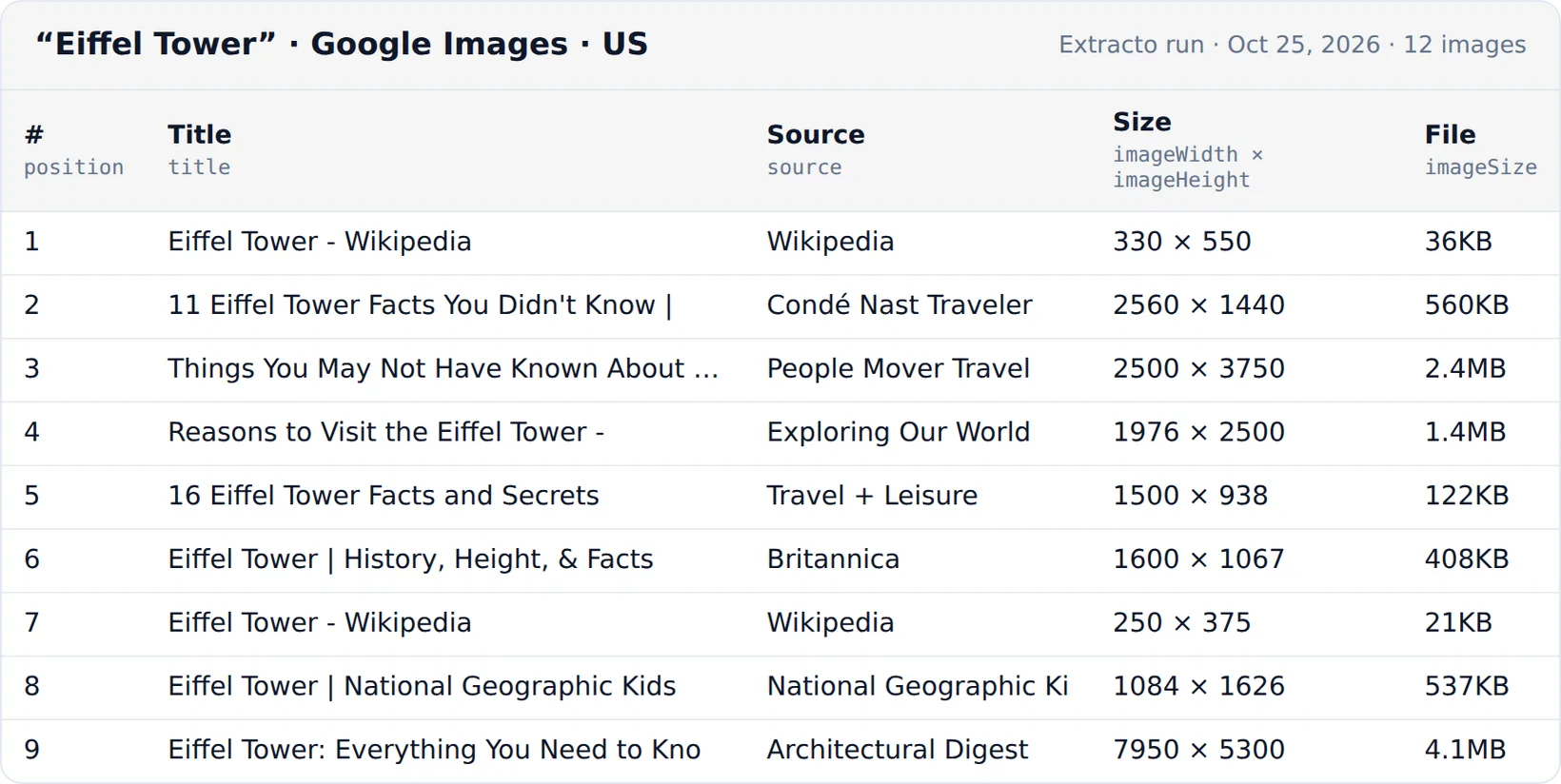
The Google Images Scraper works as a Google Images search API: give it search terms, a country and a language, and the maximum number of images per term. Each image comes back as a row:
| Field | What it contains |
|---|---|
| position, title | Rank in the results and the image title |
| imageUrl, imageWidth, imageHeight, imageSize | The full-size image link, its dimensions and file size |
| thumbnailUrl, thumbnailWidth, thumbnailHeight | Google's thumbnail |
| link, source, domain | The page the image appears on and the site name |
| googleUrl, googleImageId | The image's Google result link and ID |
Images are not downloaded, only their links and details, and the rights stay with their owners. It costs $0.069 / 1,000 results, so 10,000 images cost $0.69.
Google Lens and reverse image search
Google's Lens pages describe consumer features only; there is no developer API or SDK. The Google Lens Scraper fills that gap as a Google reverse image search API: give it a public image URL and it returns Lens's visual matches, each with the page link, title, site, thumbnail, image URL and dimensions.
One result is one searched image with all its matches, up to two images per task. The image must be publicly reachable by URL, and the exact-match and AI tabs are not collected. Use it to find where a product photo is reused, to track copies of your images, or to identify a product from a photo.
Google Images API in Python
import requests

response = requests.post(
    "https://extracto.cloud/api/v1/parsers/google-images-scraper?wait=1",
    headers={"X-API-KEY": "ext_your_api_key", "Idempotency-Key": "images-eiffel-2026-11-20"},
    json={"input": {"queries": ["Eiffel Tower"], "maxResultsPerQuery": 20, "gl": "us", "hl": "en"}},
    timeout=600,
)
for img in response.json()["data"]:
    if (img.get("imageWidth") or 0) >= 1200:  # keep large images only
        print(img["imageWidth"], img["imageHeight"], img["imageUrl"], img["link"])
Is there a free Google Images API?
No Google Images API free tier is open to new users. Custom Search had 100 free queries a day but no longer takes new customers, and Cloud Vision's 1,000 free units a month cover reverse matching, not keyword search. The scrapers are pay per result, with 2,500 trial credits for new accounts.
What people use image search data for
- Dataset collection: image URLs and sizes for a list of terms, filtered by resolution.
- Brand and copyright monitoring: where your product photos or artwork appear, with Lens matches.
- SEO: which pages rank in Google Images for your keywords and how large their images are.
- Product research: identify a product from a photo and find the stores selling it.
Using images you find
Search results show images owned by others. Collecting links and metadata for research is different from reusing the images: to publish or train on them you need a licence or another legal basis, and the rules differ by country. Keep the source page for every image so you can check its terms.