What is a SERP API?
SERP stands for search engine results page. A SERP API takes a keyword, a country and a language, runs the search through its own infrastructure and returns what the page showed as JSON. You do not deal with proxies, CAPTCHAs or HTML parsing; the provider keeps the parser working when Google changes its layout.
Most SERP scraper APIs work the same way: one request per keyword and page, results back in a few seconds, billing per successful request. The differences are in what each response contains, how deep you can go, and what counts as one billable unit.
What the Google Search Scraper returns
| Part of the page | Fields |
|---|---|
| Organic results | Position, title, URL, displayed URL, snippet, website name, date where Google shows one, sitelinks |
| People Also Ask | The questions shown on the first page (optional) |
| Related searches | Suggestions from the bottom of the first page (optional) |
| AI Overview | The AI Overview block when Google shows one for the query |
| Search details | Query, country, language, device, page number, total results estimate, whether there is a next page |
| Ads (add-on) | Paid results, when you turn on ads extraction |
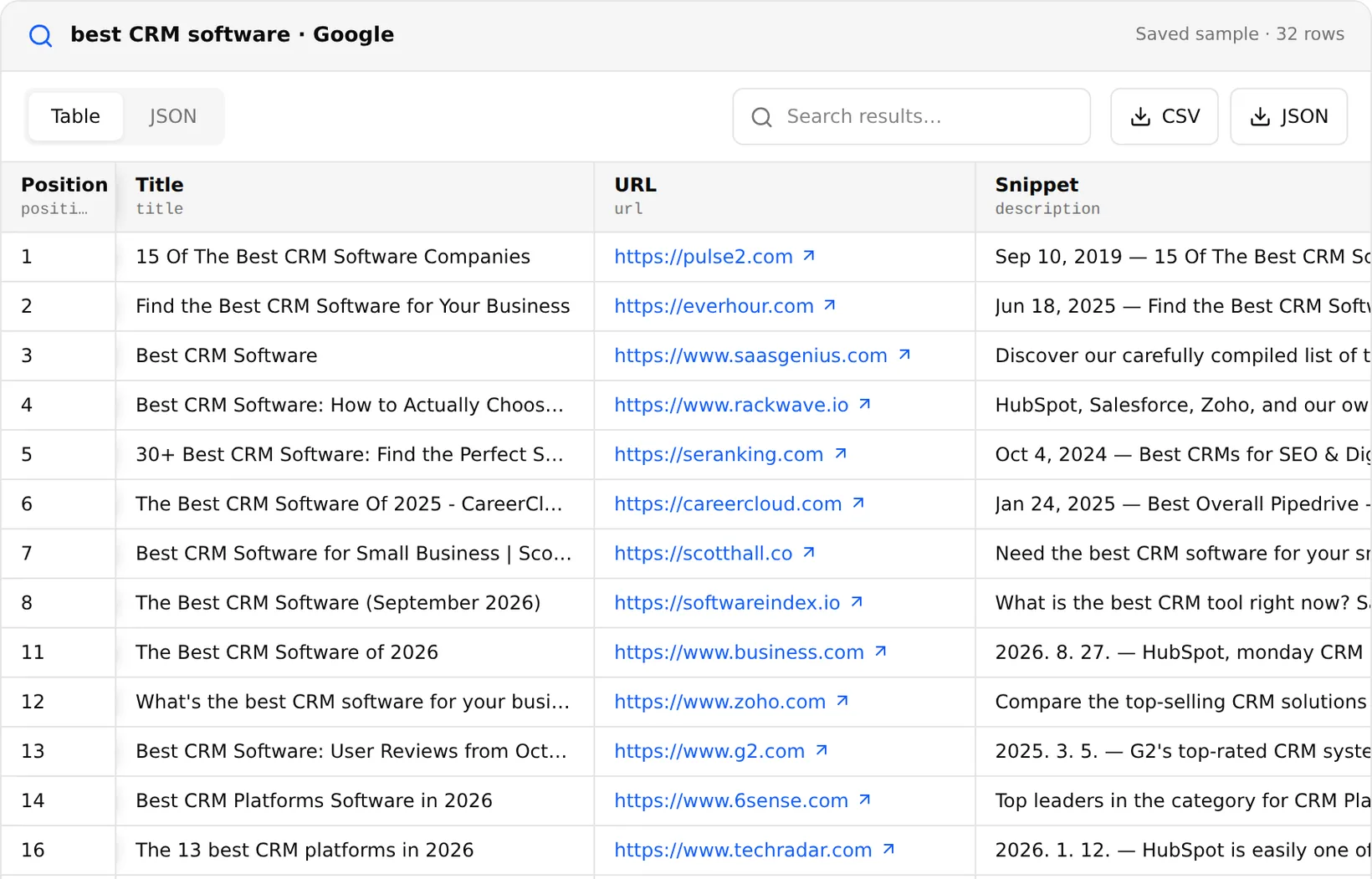
As a Google SERP API it covers any country and language. Set the country and language (for example us and en), choose desktop or mobile results, force an exact-match search, and fetch up to 10 pages per query. You can also paste Google search URLs with filters already applied. One billable result is one results page, so 1,000 pages cost $1.50.
SERP API pricing compared
Prices below were checked on the providers' pricing pages on November 20, 2026. Each provider counts differently, so the per-1,000 figure is per search, per page or per 10 results as noted.
| Provider | How it bills | Entry price | At volume | Free allowance |
|---|---|---|---|---|
| SerpApi | Monthly plan, per search | $25 for 1,000 searches ($25 per 1,000) | $725 for 100,000 ($7.25 per 1,000); $3,750 for 1M ($3.75 per 1,000) | 250 searches a month |
| Serper | Prepaid credits, valid 6 months | $50 for 50,000 ($1.00 per 1,000) | $3,750 for 12.5M ($0.30 per 1,000) | 2,500 queries on signup |
| DataForSEO | Pay as you go, per SERP of 10 results | Live: $2.00 per 1,000; Standard queue: $0.60 per 1,000 | Each extra 10 results adds the base price again; $50 minimum top-up | $1 trial credit |
| Bright Data | Pay as you go or monthly plan, per request | $1.50 per 1,000 | $499 a month for 380,000 requests | 5,000 requests |
| Extracto | Pay as you go, per results page | $1.5 / 1,000 search result pages | Same price at any volume | 2,500 trial credits |
The best SERP API is not always the one with the lowest headline price. A cheap SERP API with a queue that answers in minutes is fine for daily rank tracking but not for an app waiting on the result; a monthly plan is wasted if your volume is uneven. SerpApi counts only successful searches, and DataForSEO refunds depth you did not receive, so failed requests should not cost you with either. For a wider look at scraping APIs, see the best web scraping APIs.
Is there a free SERP API?
SERP API free tiers exist for small volumes: SerpApi's free plan gives 250 searches a month, Serper gives 2,500 queries once, and Bright Data has a 5,000-request free tier. None of them is free at scale.
Google's own option is going away. The Custom Search JSON API gave 100 free queries a day and charged $5 per 1,000 after that, but it is closed to new customers and existing customers have until January 1, 2027 to move to something else. Google points site-search users to Vertex AI Search, which covers up to 50 domains, not the whole web, so for full web results a third-party SERP API alternative is the remaining option.
Bing, Yahoo, DuckDuckGo and AI answers
| Scraper | What it returns | Price |
|---|---|---|
| Bing Search Scraper | Position, page, title, URL, snippet. In our checks Bing returned 10 first-page results per query. | $0.03 / 1,000 results |
| Yahoo Search Scraper | Title, URL and snippet of web results | $0.8 / 1,000 results |
| DuckDuckGo Search Scraper | Title, URL, snippet, with a time-frame filter | $0.6 / 1,000 results |
| Google AI Mode Scraper | The AI Mode answer and its cited sources | $3 / 1,000 results |
| Google Autocomplete Scraper | Search suggestions for seed phrases, with a–z and question expansion | $0.01 / 1,000 results |
A Bing SERP API is worth adding when you track rankings outside Google or audit how your pages show up on other engines. It is also far cheaper per result than Google.
For image results and reverse image search, see the Google Images and Lens API guide.
For news results specifically, see the Google News API guide.
DuckDuckGo’s own API returns Instant Answers only; for its web results see the DuckDuckGo API guide.
Rank tracking with a SERP API
A SERP tracking API is the same data used on a schedule: run your keyword list every day or week for each country you care about, find your domain in the organic results and store the position. One results page per keyword per day is enough for most tracking; fetch more pages only for keywords where you rank below 10.
Using a SERP API in Python takes a few lines. This script sends two keywords to the Extracto API and prints where a domain ranks on the first page:
import requests

DOMAIN = "hubspot.com"
response = requests.post(
    "https://extracto.cloud/api/v1/parsers/google-search-scraper?wait=1",
    headers={"X-API-KEY": "ext_your_api_key", "Idempotency-Key": "rank-check-2026-11-20"},
    json={"input": {"queries": ["best crm software", "crm for small business"],
                    "countryCode": "us", "languageCode": "en", "maxPagesPerQuery": 1}},
    timeout=600,
)
for page in response.json()["data"]:
    query = page["searchQuery"]["term"]
    hits = [r["position"] for r in page["organicResults"] if DOMAIN in r["url"]]
    print(query, "->", hits[0] if hits else "not on page 1")
The same request works from any language. The scraper page lists every input and output field, and our Python scraping guide covers the basics.
Rankings show where you stand; search interest shows where demand is going. For the second, see the Google Trends API guide.
Building your own Google search scraper
A Google search results scraper written from scratch works for a few queries and then hits CAPTCHAs, because Google blocks automated traffic quickly. Keeping one running means rotating residential proxies, rendering pages in a browser and fixing selectors whenever the results page changes, which is the work a SERP API provider does for you. Open-source scrapers on GitHub are a good way to learn, but check when they were last updated before relying on one.
Is using a SERP API legal?
Search results are public, and collecting them is widespread in the SEO industry. Search engines' terms of service restrict automated queries, though, and the law differs by country, which is why some providers sell legal protection as a feature (SerpApi includes a Legal Shield from its Production plan up). Use the data for analysis, respect copyright in the pages you link to, and do not republish full result pages as your own content.