What the Indeed job scraper collects
| Data | Fields |
|---|---|
| Job | Title, job key (ID), job URL, publish date, language |
| Employer | Company name and parent company, employer attributes |
| Location | City, state, country |
| Details | Base salary, job types, benefits, occupations, attributes and the full description, when the listing has them |
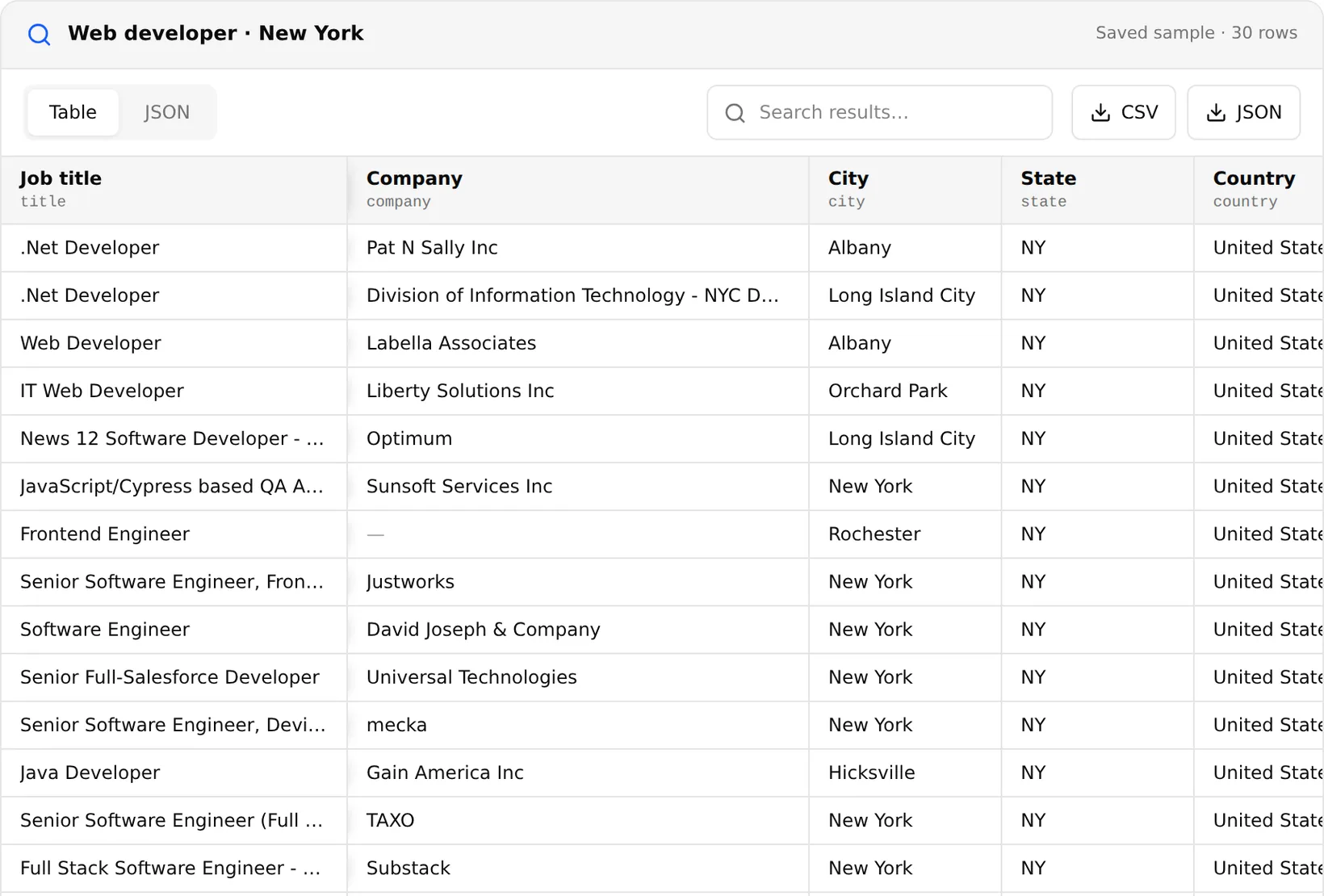
As an Indeed data scraper it returns the same listings a job seeker sees. Salary and benefits appear only when the employer publishes them, so expect gaps. The job key is stable, which makes it the right column for removing duplicates across runs.
How to scrape Indeed step by step
- Open the Indeed Jobs Scraper.
- Choose a country, then enter a job title, keyword or company and a city, state, ZIP code or
remote. - Set the posting window (for example the last 7 days) and a maximum number of jobs.
- Run and export to CSV, JSON or Google Sheets. At $0.1 / 1,000 results, 10,000 jobs cost $1.00.
To cover a whole market, run one search per job title and city, then merge on the job key. A weekly run with a 7-day window gives you a clean time series of new postings.
Indeed vs LinkedIn, Glassdoor and Google Jobs
| Scraper | Search by | What it adds | Price |
|---|---|---|---|
| Indeed | Country, title or keyword, location, date posted | Salary, benefits, job types, description | $0.1 / 1,000 results |
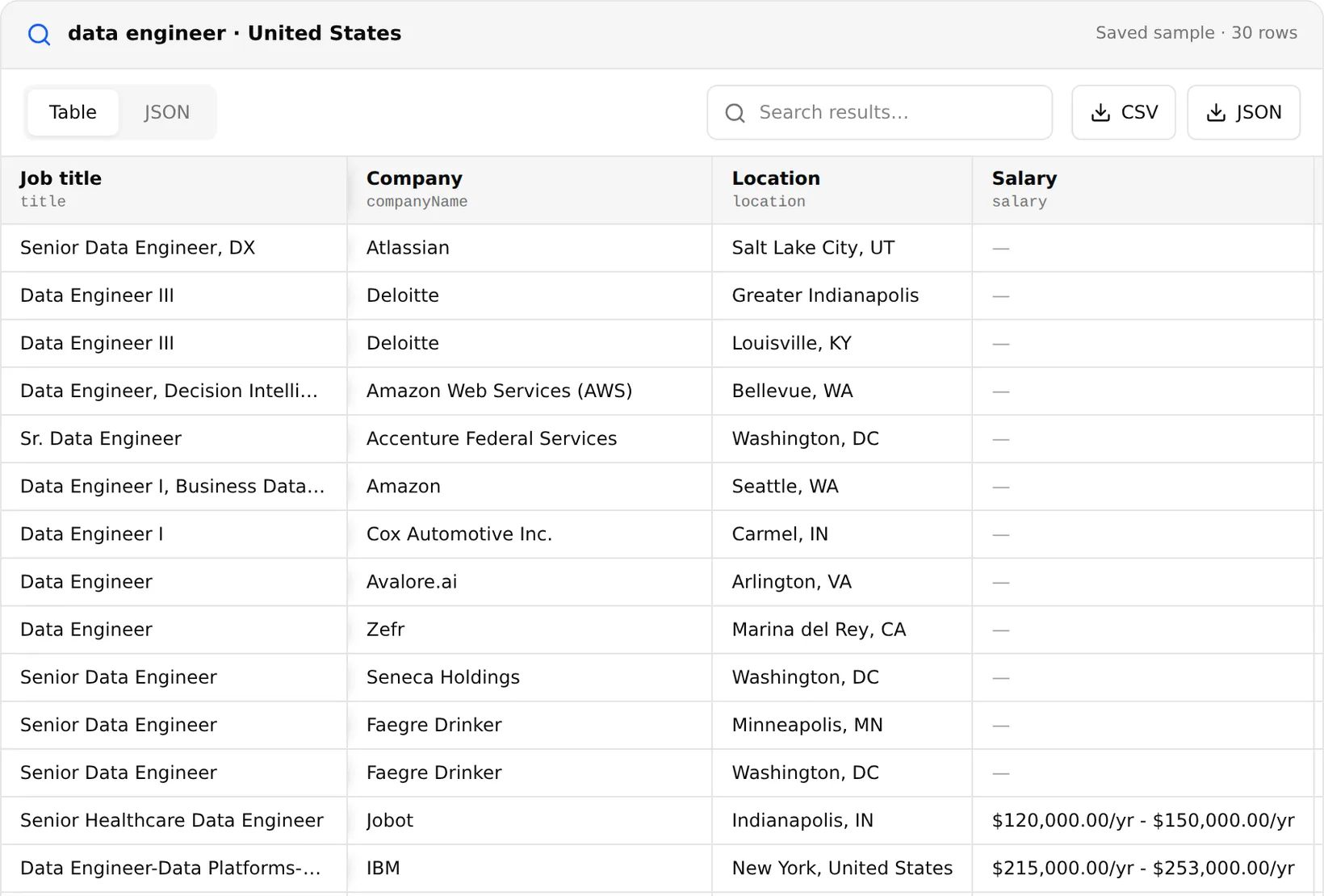
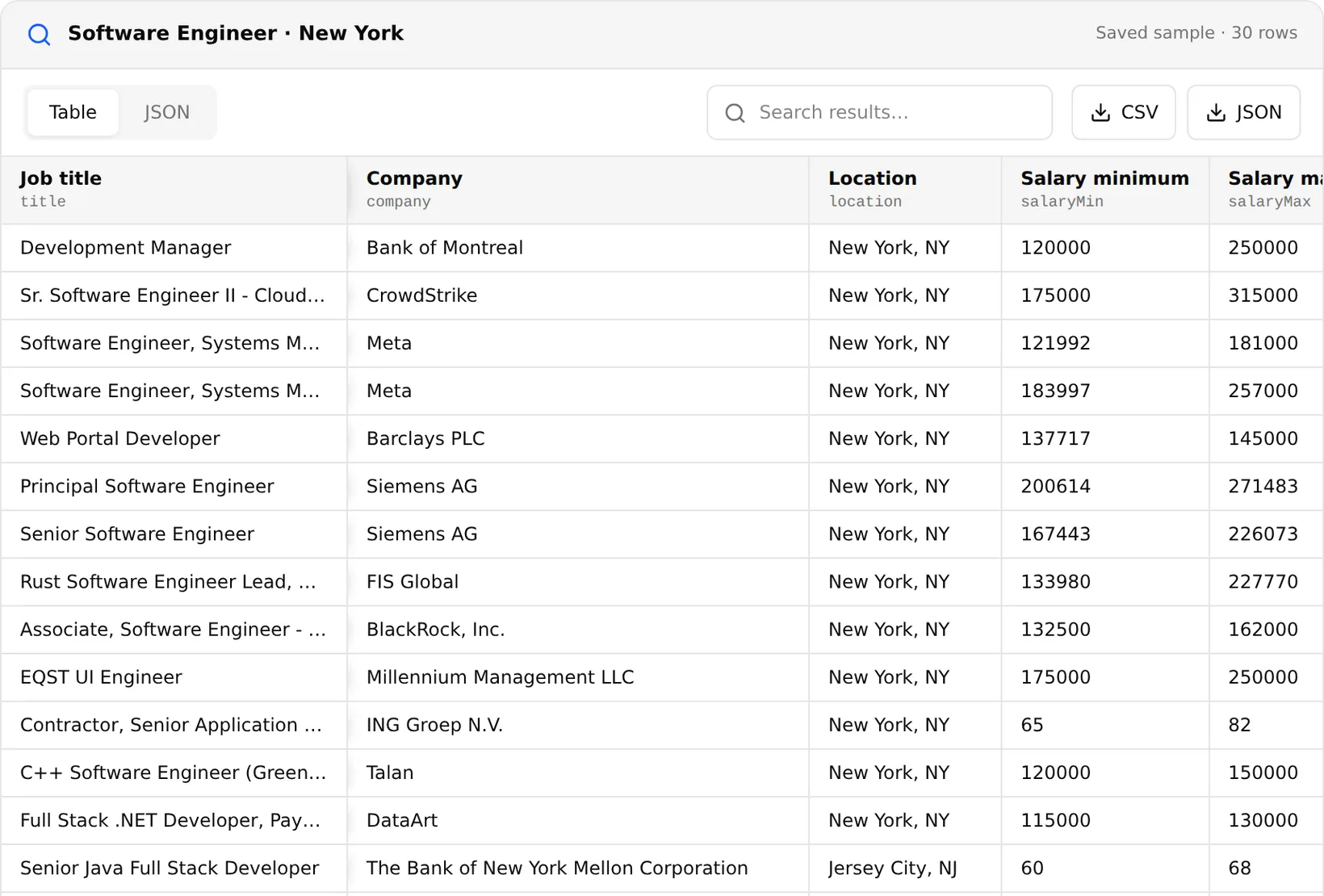
| LinkedIn Jobs | Keywords, location, search URLs, company pages | Applicant count, seniority, employment type, optional company profile | $1.13 / 1,000 results |
| Glassdoor | Keywords, location, radius, days old, company size, minimum rating | Pay range and period, employer rating, Easy Apply filter | $0.4 / 1,000 results |
| Google Jobs | Keyword, location, country and language | Listings gathered from many boards, apply links, description | $0.5 / 1,000 results |
As a LinkedIn job scraper, the LinkedIn Jobs Scraper accepts job-search URLs copied from your browser. Keyword, location, date and company filters in the URL are applied; experience level, job type, workplace and salary filters are not. Turning on company details adds each employer's website, size and industry, and makes runs slower.
Glassdoor is the board to use for pay data: its listings often carry a salary minimum, maximum and period. Google Jobs is a useful cross-check because one search returns listings that employers posted on many different sites.
LinkedIn also has company pages worth collecting alongside the jobs: see the LinkedIn scraper guide.
Indeed scraper API
Every job scraper runs through the Extracto API. This request returns web developer jobs in New York posted in the last 7 days:
curl --request POST 'https://extracto.cloud/api/v1/parsers/indeed-jobs-scraper?wait=1' \
  --header 'X-API-KEY: ext_your_api_key' \
  --header 'Idempotency-Key: indeed-webdev-2026-11-20' \
  --header 'Content-Type: application/json' \
  --data '{"input": {"country": "us", "title": "Web developer", "location": "New York", "limit": 100, "datePosted": "7"}}'
No-code tools work too. An n8n Indeed scraper is just an HTTP Request node calling this endpoint on a schedule, followed by a node that writes the rows to a sheet or database.
Indeed's API, Python, GitHub and extensions
Indeed used to offer a public job search API through its Publisher program, but it no longer does. The APIs Indeed offers today are for partners such as applicant tracking systems and job boards that post jobs and receive applications; they do not let you search Indeed's listings. LinkedIn's job APIs are likewise limited to approved partners.
That leaves scraping. An Indeed scraper in Python or an Indeed scraper from GitHub works until Indeed's bot protection blocks it, which tends to happen quickly at volume. Indeed scraper Chrome extensions export the page in front of you, which is fine for a few searches. A hosted Indeed web scraper with an API is the low-maintenance option. If you are comparing hosted Indeed scrapers, compare the price per 1,000 jobs and whether salary and description are included.
What people use job data for
- Hiring signals for sales: companies hiring for a role are often buying related tools.
- Labour market research: demand for skills by city and how it changes month to month.
- Salary benchmarks: published pay ranges by title and location, mostly from Glassdoor and Indeed.
- Job boards and alerts: niche boards that aggregate listings in one field, linking back to the original posts.
Does Indeed allow scraping?
Indeed's terms restrict automated access to its site, and the same is true of LinkedIn and Glassdoor. The listings themselves are public. Collect what you need for analysis, link to the original posting instead of copying full descriptions onto your own site, and treat recruiter names and contact details as personal data.