Does Google Flights have an API?
No, not for searching flights. Google's flights developer pages describe Google Flights as a free metasearch engine and offer onboarding for two groups: airlines and online travel agencies that want their fares and booking links to appear on Google Flights. That is a feed into Google, not a search API out of it, and the specification is shared under NDA with selected, invite-only partners.
Google's older QPX Express API, which once offered fare search to developers, is no longer available. So a search for a "Google Flights developer API" or a flights.google.com API ends in the same place: there is no official endpoint that returns the results of a Google Flights search.
Getting Google Flights data with a scraper
The Google Flights Scraper runs a Google Flights search and returns each flight as a row. You give it the origin and destination as airport or city codes (JFK, NYC), the departure date and, for a round trip, the return date, plus passengers, cabin class and the maximum number of stops. One task searches one route.
| Data | Fields |
|---|---|
| Price | Price and currency, whether Google marks it as the cheapest or best flight, and Google's price level with the typical price range for the route |
| Flight | Airline, airline codes, flight numbers, stops and layovers, departure and arrival airports and times, total duration |
| Each leg | Flight number, operating carrier, aircraft, legroom, in-seat amenities |
| Extras | Carry-on bags included, CO₂ emissions and how they compare with typical flights on the route, a link to the search on Google Flights |
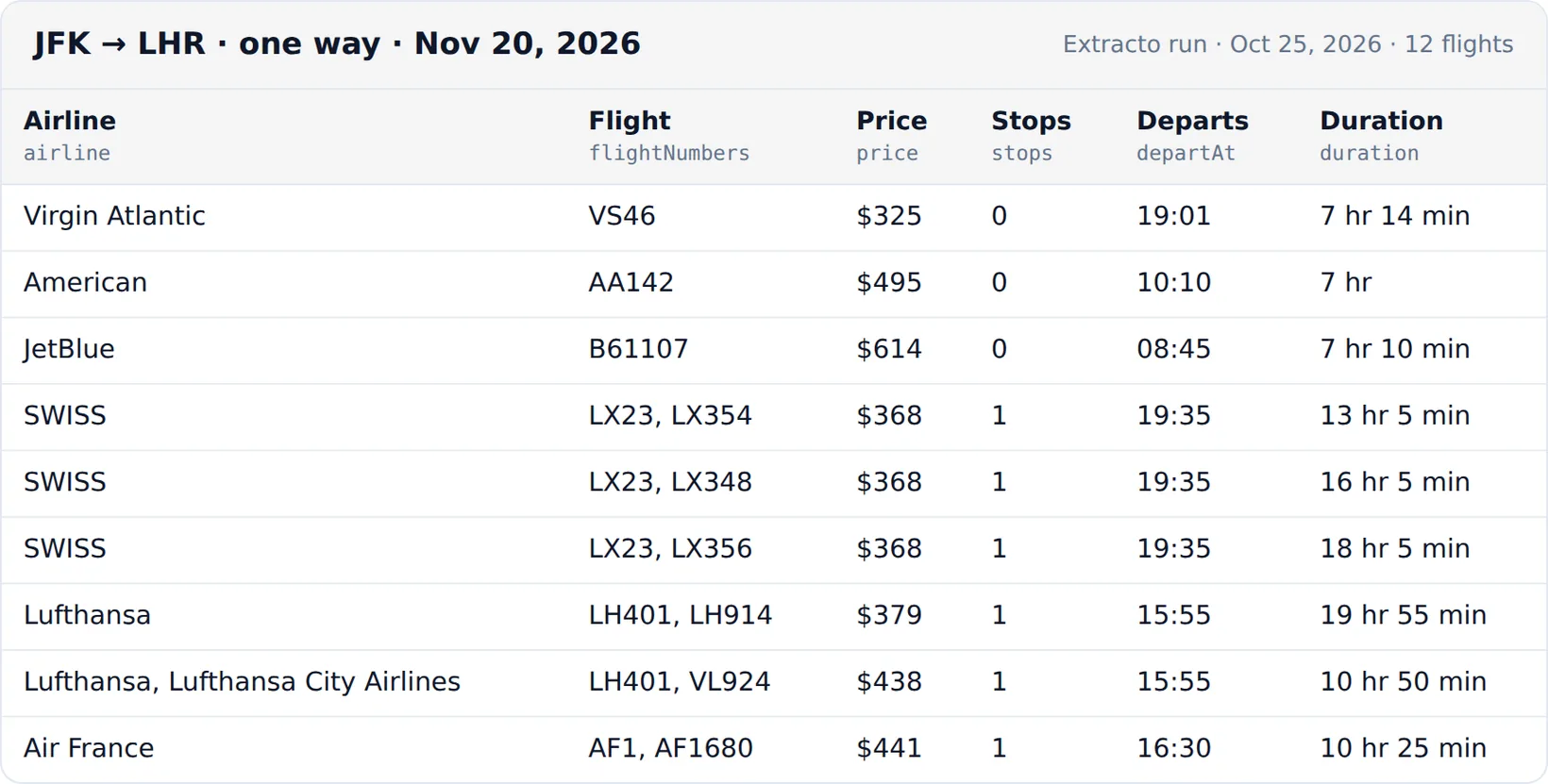
In the run shown below, Google labelled prices on the route as high, with a typical range of $170 to $300, while the cheapest nonstop was $325. That context is useful for fare alerts: you can flag a price as a deal relative to what Google considers normal for the route.
Google Flights API in Python
You call the scraper like an API. This Python request searches one-way flights from New York to London and prints the cheapest options:
import requests

response = requests.post(
    "https://extracto.cloud/api/v1/parsers/google-flights-scraper?wait=1",
    headers={"X-API-KEY": "ext_your_api_key", "Idempotency-Key": "jfk-lhr-2026-12-15"},
    json={"input": {"origin": "JFK", "destination": "LHR", "departureDate": "2026-12-15",
                    "adults": 1, "cabinClass": "economy", "maxStops": 1}},
    timeout=600,
)
flights = response.json()["data"]
for f in sorted(flights, key=lambda f: f["price"] or 10**9)[:5]:
    print(f["airline"], f["flightNumbers"], f["price"], f["currency"], f["stops"], "stops", f["duration"])
Google Flights API GitHub projects take another route: they reverse-engineer the requests the Google Flights page makes. They are free and fun to study, but they break when Google changes the page and offer no protection against blocking, so check how recently a project was updated before you build on it.
Is there a free Google Flights API?
No Google Flights API free tier exists, because there is no official API at all. Scraping is pay per use: $0.2 / 1,000 results, so monitoring 20 routes once a day with about 12 flights each costs roughly $1.44 a month. New accounts get 2,500 trial credits to test it.
What people use Google Flights data for
- Fare monitoring: check a set of routes daily and alert when the price drops below Google's typical range.
- Route research: which airlines fly a route, how many nonstops there are and at what times.
- Travel content: current price ranges for destination guides, refreshed weekly.
- Market analysis: how fares move as the departure date approaches.
Limits to know
- Fares are time-sensitive and may be missing for some flights. They are what Google displayed at collection time, not bookable offers.
- One task covers one route and date. For a date range or many routes, run several tasks.
- Calendar views, return-flight selection and airline booking pages are not collected.