What you can scrape from the app stores
| Scraper | Input | Main fields | Price |
|---|---|---|---|
| Google Play Reviews | Up to 50 package names or Play URLs | Rating, text, date, thumbs-up count, app version, reviewer name | $0.08 / 1,000 results |
| Google Play Search | Search terms, country, language, free or paid | Title, rank, rating, ratings count, installs range, developer and contact details, category, price, description | $0.115 / 1,000 results |
| Google Play Top Charts | Top Free or Top Paid, category, countries | Chart position, title, rating, installs, price, developer, release and update dates, in-app purchases | $0.5 / 1,000 results |
| App Store Reviews | Up to 50 App Store IDs or URLs | Rating, title, text, date, developer reply, edited flag | $0.08 / 1,000 results |
| App Store Search | Search terms, storefront, language | App name, rank, rating and count, developer, genre, price, version, release notes | $0.037 / 1,000 results |
| App Store Top Charts | Top Free or Top Paid, genres, countries | Rank, app name, price, developer, category, release date | $0.8 / 1,000 results |
Google Play review scraper
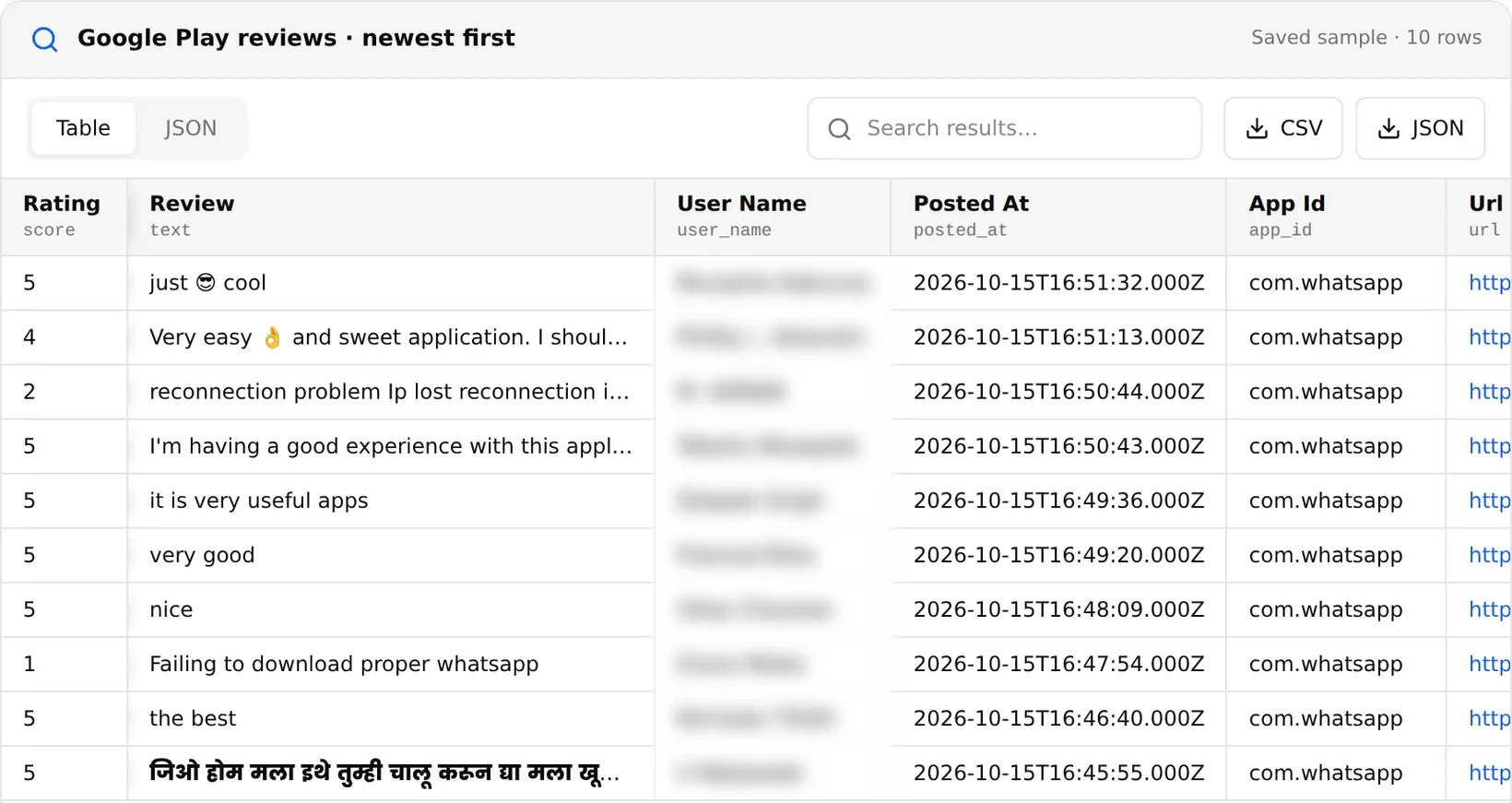
The Google Play Reviews Scraper takes package names such as com.whatsapp or Play Store URLs, up to 50 apps per task, and reads review pages until it has the number you asked for. Sort by newest, rating or relevance, and pick the store country and language: Google Play localises which reviews it returns, so the same app shows different reviews in us and de. Reviewer names are included; collect and keep them only if you need them.
For Apple, the App Store review scraper (App Store Reviews) does the same with numeric App Store IDs, sorted by most recent, most helpful or other orders Apple offers, and returns the developer's reply where there is one. Apple serves a separate review set for each country storefront. 10,000 reviews cost $0.80 on Google Play.
Search results and top charts
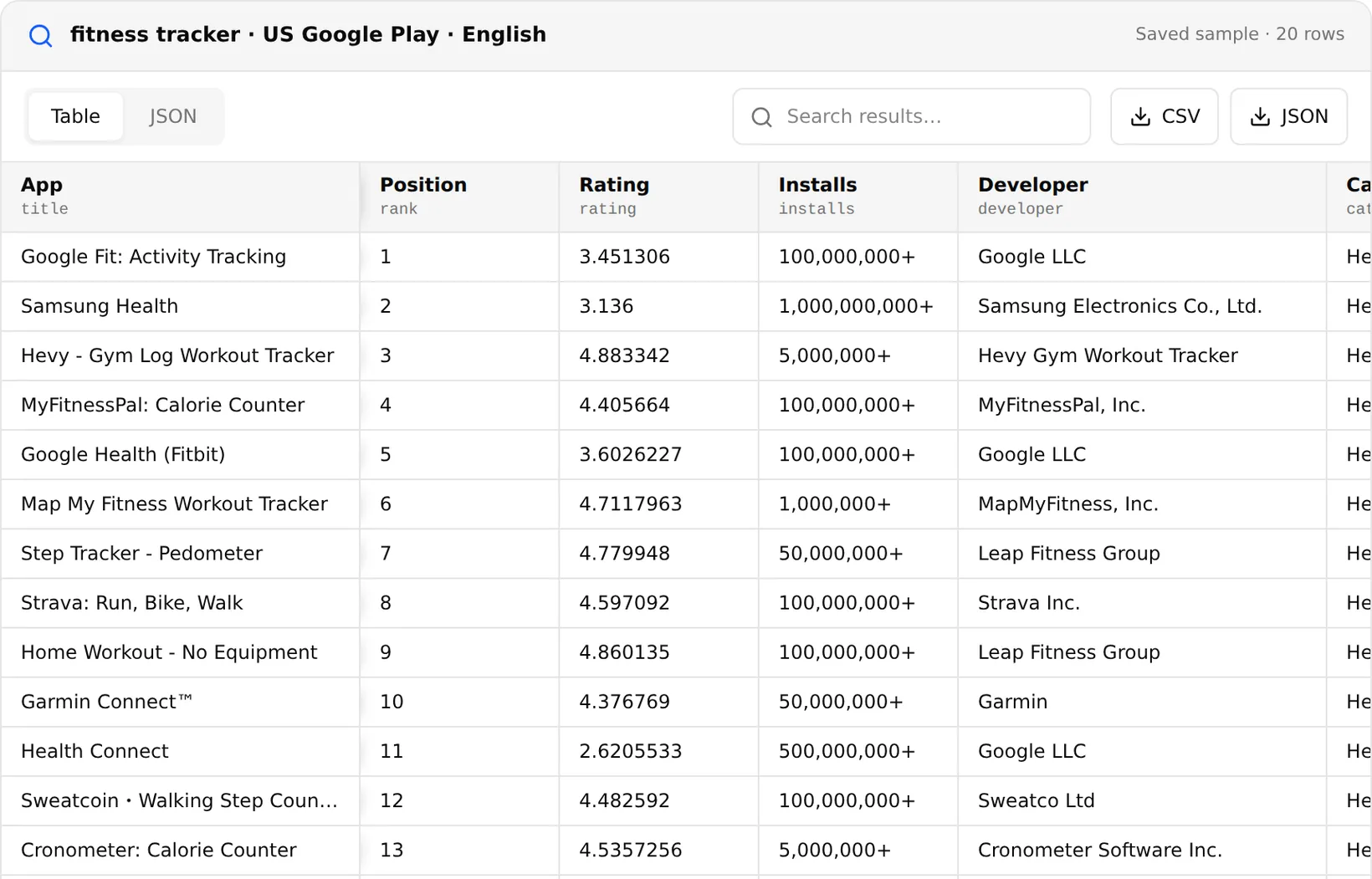
The Google Play Store scraper for search returns the apps Google Play shows for a term, with ratings, install ranges and the developer's published contact details, which makes it useful for finding app developers to contact. Install counts are Google's public ranges, such as 100,000,000+, not exact downloads.
The top charts scrapers take a snapshot of Top Free and Top Paid charts for the countries and categories you choose: up to 200 entries per chart on Google Play and 100 on the App Store. Run them daily to build a ranking history; the stores do not provide one.
What the official store APIs allow
- Google Play Developer Reply to Reviews API: lets you view and reply to reviews for your own app. It returns only reviews created or modified within the last week, and only reviews with comments, with a quota of 200 reads an hour.
- Apple's iTunes Search API: public and free, returns app metadata as JSON, limited to approximately 20 calls a minute. It does not return reviews.
- Competitors' reviews: neither store offers an API for other developers' reviews, which is why review scrapers exist.
google-play-scraper on npm and PyPI
Many developers start with an npm Google Play scraper or a Python package: google-play-scraper on npm for Node.js and the Python package of the same name, plus app-store-scraper for Apple. They are a fine way to test an idea. The Node.js library's README now says its author no longer actively maintains it beyond reviewing community pull requests and warns that the parser will break when Google Play's layout changes. Libraries also run from your IP, so large jobs hit rate limits. A hosted Google Play scraper API handles both.
Google Play scraper in Python
Through the Extracto API, a Google Play scraper in Python is one request. This one collects the latest reviews of two apps and counts low ratings:
import requests
from collections import Counter

response = requests.post(
    "https://extracto.cloud/api/v1/parsers/google-play-reviews-scraper?wait=1",
    headers={"X-API-KEY": "ext_your_api_key", "Idempotency-Key": "play-reviews-2026-11-20"},
    json={"input": {"appIds": ["com.whatsapp", "org.telegram.messenger"], "maxReviews": 200,
                    "sort": "newest", "country": "us", "language": "en"}},
    timeout=600,
)
low = Counter(r["app_id"] for r in response.json()["data"] if r["score"] <= 2)
print(low)  # 1- and 2-star reviews per app
The App Store scraper Python call is the same with app-store-reviews-scraper and numeric app IDs. App Store scraper GitHub projects have the same maintenance problem as the Google Play libraries.
What people use app store data for
- Review analysis: recurring complaints after each release, by version and country.
- Competitor tracking: ratings, install ranges and update dates of rival apps.
- ASO: which apps rank for your keywords in search and charts.
- Lead generation: developers' published emails and websites from search results.
- Combined feedback: add Google Maps reviews or Trustpilot for the full picture.
Is it legal to scrape app store reviews?
Reviews and app pages are public, but store terms restrict automated access and reviewer names are personal data. Analyse reviews in aggregate, do not republish them with names, and use the official APIs to reply to reviews of your own apps.